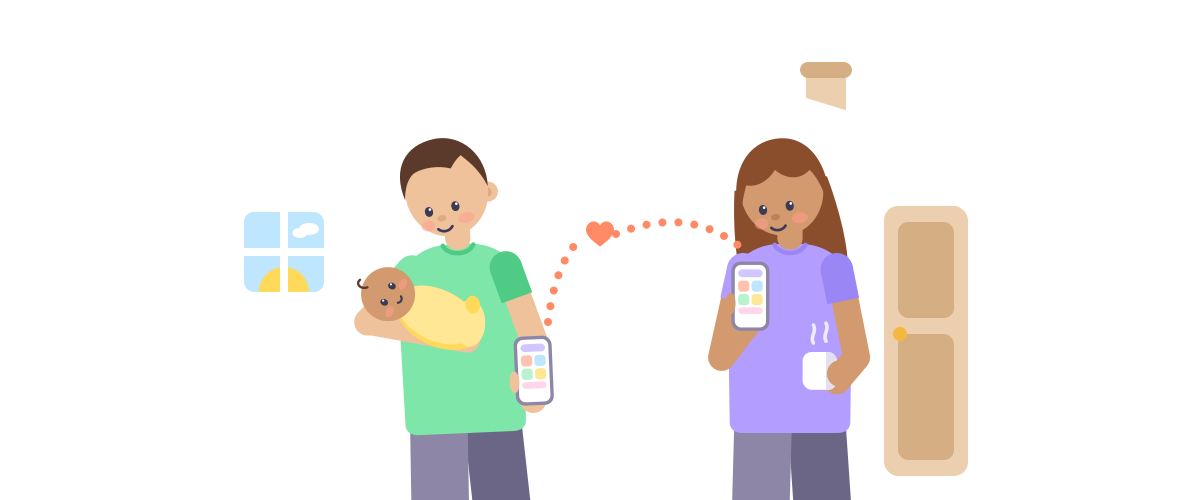
Sharing the mental load when two people track one baby
The person holding the schedule in their head is doing work even when their hands are empty. Here is how two caregivers can hand some of it over.
Someone in your home knows that the last feed was at 2:40 and on the left, that there are 4 diapers left in the pack under the changing table, that the next checkup is on a Tuesday, and that the baby went down 40 minutes ago so the window is closing. That person is working right now, even with empty hands.
This is the part of new parenthood that survives every fair division of chores. You can split the bottles and the laundry down the middle and still have one person carrying the whole schedule in their head all day.
The work nobody can see
It has a name and a research literature. In a 2019 study in the American Sociological Review, the sociologist Allison Daminger interviewed 70 people from 35 couples and argued that the non-physical side of running a household is a distinct kind of work: cognitive labor. She breaks it into four parts — anticipating a need, identifying the options, deciding between them, and monitoring how it turns out.
Two of her findings land hard at 3 a.m. The first is that this work is taxing but often invisible to both the person doing it and their partner, which is why she found it a frequent source of conflict. The second is that it was not split evenly: in her interviews, women did more cognitive labor overall, and more of the anticipating and monitoring in particular — while participation in the deciding itself was roughly equal.
Your household may look nothing like the ones in that study. Two mothers, two fathers, a parent and a grandparent, a single parent and the friend who takes Thursdays — the shape tends to be the same. One person becomes the one who knows, and everyone else, with good intentions, becomes staff.
The person holding the whole schedule in their head is working even when their hands are empty.
Why “just ask me” doesn’t move it
“Just ask me and I’ll do it” is meant generously. In practice it keeps every route running through one person: they remember, decide, explain, and then check that it happened. Anticipating and monitoring were exactly the parts Daminger found women carrying disproportionately — and they are the parts “just ask me” hands straight back.
What moves the load is when the second person can find the answer without asking, and owns a whole area including the noticing. Not “change the diaper when I tell you,” but “diapers are yours — the changing, the counting, and knowing when the pack is nearly out.”
What a shared log actually changes
A record you can both see does three things to the invisible work.
- The handover stops being a briefing. No 90-second download at the door while one of you holds a crying baby and the other is still in a coat.
- Whoever is coming on shift can read the day themselves. When the last feed was, which side or how much, how long the last stretch of sleep ran. The question shrinks to “anything I should know?” — instead of “what happened today?”, which has to be reconstructed by someone who hasn’t slept.
- The same decisions stop being relitigated. If you both know the baby went down at 1:10, neither of you has to argue about whether it has been long enough. If you plan naps around wake windows, what the clock is actually telling you is worth reading together.
Once you have shared the baby with the other person — sharing stays off until you send them a code — Bunavi keeps both phones in sync, so a bottle logged at 3 a.m. is on your partner’s phone before they wake. This is not an app trick — a notebook on the kitchen counter does the same job and never loses sync. What matters is that the record lives somewhere other than one person’s memory. Sharing does mean it leaves that phone for a server somewhere, and it is fair to ask which country that is; where your baby’s data lives covers that.
Agree on what you’ll log — and what you won’t
Two people logging different things is worse than one person keeping a private list. Decide once, together, while you are both awake. The working rule: log what answers a question one of you actually asks, and skip the rest.
| What you log | The question it answers | When you can let it go |
|---|---|---|
| Feeds — time, side or amount | When did the baby last eat, and whose turn is next? | When you both feel the rhythm without checking |
| Sleep — start and end | How long has the baby been awake? | When it stops changing what you do |
| Diapers | Are we where our midwife or pediatrician asked? | When they stop asking |
| Weight and length at checkups | How is this going over months, not days? | Keep it — a few taps a month |
If a midwife or pediatrician asked you to count wet and dirty diapers in the early weeks, that one is worth the taps until they say otherwise — what those counts are for is a post of its own. Growth entries earn their place for the opposite reason: they only mean anything across months, and a single point says very little — the subject of what a percentile actually means.
Three house rules prevent most log arguments: one entry per event, whoever has a free hand makes it, and nobody edits the other person’s entries to be more precise. A rough log both of you trust beats an exact one that one of you polices.
Splitting the night before the night starts
Decide the shifts at dinner, not at 4 a.m. At 4 a.m. whoever surfaces first does it, and that is never a fair coin — it is the same person every time, already listening for the sound in their sleep.
The American Academy of Pediatrics, on its HealthyChildren site, suggests partners take shifts with diaper changes, feedings if the baby is bottle-fed, and the rocking and calming. If the baby takes a bottle — formula, expressed milk, or both alongside the breast — the feeds themselves can alternate, so the shift is a real one. If one of you is breastfeeding at night, the night still splits a different way: the other does the changing, the settling, and the putting-down, so the feeding parent is awake for the feed rather than the whole hour. Name the boundary out loud — “you have everything until 2, I have everything after” — and let the off-duty parent sleep where they cannot hear every noise.
If your hardest hours are between dinner and midnight, the shift may need to start at 6 p.m.; cluster feeding in the evenings explains why that stretch can feel relentless.
HealthyChildren.org, the AAP’s parent site, advises against feeding your baby on a couch or armchair, because of the risk if you fall asleep there. If you do fall asleep, place your baby on their back in their crib or bassinet as soon as you wake.
When tracking becomes its own pressure
A log can quietly become one more thing you are failing at. You will know when you feel behind because of a gap in an app rather than anything to do with your baby, when you are logging things neither of you has read in weeks, or when the record becomes a scoreboard of who did more.
Turn those categories off. Stop for a week and see whether you miss anything — with one exception: if a midwife or doctor has asked you to keep counting something, keep counting that one, and tell them it is feeling like too much rather than quietly dropping it. A day with no entries is not a day with no care — it is a day you were busy doing it instead of writing it down. The record exists to take work off someone; when it starts adding work, it has stopped doing its job.
When it is heavier than tiredness
Exhaustion in these months is ordinary. A low mood that does not lift is a different thing, and either of you can be the one carrying it, whether or not you gave birth.
The NHS says symptoms of postnatal depression can begin during pregnancy, soon after birth, or up to a year after your baby is born, and that fathers and partners can have depression after a baby too. It advises speaking to a GP, midwife, or health visitor if you think you might have it, and says it is important to get help even if you only have some of the signs. Elsewhere, that first conversation may be with your family doctor.
None of this needs a family meeting. It needs one 10-minute conversation about who owns what, one place you both look, and the agreement that whoever has been holding it all in their head gets to put it down.
Questions parents ask
What is the mental load, exactly?
Sociologist Allison Daminger calls it cognitive labor: anticipating a need, identifying the options, deciding between them, and monitoring the result. It is the part of caring for a baby that leaves no visible trace, which is why it is easy for both of you to miss.
How do we split the night if one of us is breastfeeding?
Decide the shifts before bed rather than at 4 a.m. The parent who is not feeding can still do the changing, the settling, and the putting-down, so the feeding parent is awake for the feed instead of for the whole hour.
Do we have to track everything?
No. Log only what answers a question one of you actually asks, which is usually feeds, sleep times, and whatever your midwife or pediatrician has asked you to count. Turn off the rest. A day with no entries is not a day with less care.
Is a shared baby tracker private?
That depends on the app. Ask where the data is stored, whether it is sold or used for advertising, and whether you can delete it yourself. Anyone you invite can see the whole log, so treat invites the way you treat house keys.
Where this comes from (4)
- Allison Daminger, “The Cognitive Dimension of Household Labor,” American Sociological Review 84(4), 2019 — Based on 70 interviews with members of 35 couples; defines cognitive labor as anticipating needs, identifying options, decision-making, and monitoring; finds it taxing but often invisible and a frequent source of conflict, with women doing more overall and more anticipation and monitoring in particular.
- American Academy of Pediatrics — HealthyChildren.org, “New Dads & Partners: How Your Involvement Matters” — Suggests partners take shifts with diaper changes, feedings (if bottle-feeding), and rocking and calming the newborn.
- American Academy of Pediatrics — HealthyChildren.org, “Safe Sleep Tips for Sleep-Deprived Parents” — Advises avoiding feeding your baby on a couch or armchair, and placing the baby on their back in a bassinet or crib as soon as you wake if you fall asleep while feeding.
- NHS — Postnatal depression — Symptoms can begin during pregnancy, soon after birth, or up to a year after the baby is born; fathers and partners can also have depression after a baby; advises speaking to a GP, midwife, or health visitor, and getting help even with only some of the signs.
Keep the whole story in one place
Bunavi logs feeds, naps, diapers and growth in one tap — and shares them live with your partner. Free to use, no ads, and your data stays in the EU.
Download free on the App Store iPhone · iOS 15.5 or later · Privacy policy