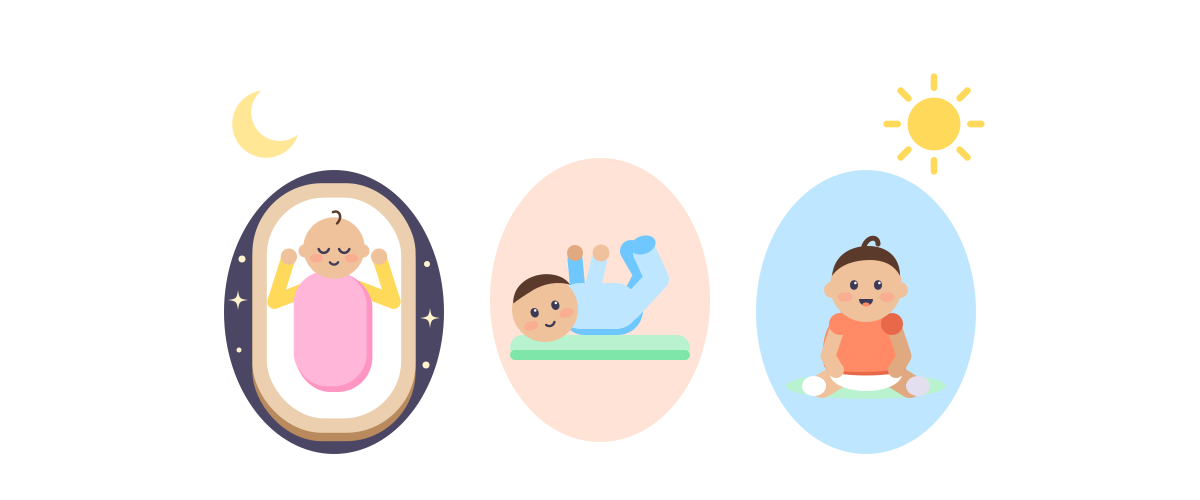
Wake windows by age: how long your baby can stay awake
Wake windows are a useful idea with a shakier evidence base than the charts suggest. Here’s how to use one without letting it run your day.
You put her down 40 minutes after she woke and she screamed. Next time you waited 90 minutes and she screamed harder. Somewhere in between is supposed to be a number that works, and every chart online gives you a different one.
Wake windows are a useful idea, and less official than the confident tables make them look. Both are worth knowing before you plan a day around one.
What a wake window is
A wake window is the stretch of time your baby is awake between one sleep and the next, measured from eyes open to eyes closed. Not from when you start settling her — from when she surfaces to when she is actually asleep.
That changes the number a lot. If she wakes at 9:00 and is asleep at 10:15 after 25 minutes of rocking, her window was 75 minutes, not the 50 before you picked her up. Counting the settling makes the number match what her body did.
Why this holds up better than a clock
Newborn sleep does not arrange itself into a timetable. The NHS says some newborns sleep a total of around 8 hours a day and others up to around 18, and that either is perfectly normal. The American Academy of Pediatrics puts the typical newborn nearer 16 to 17 hours, taken 1 or 2 at a time, and says regular sleep cycles do not appear until around 4 months.
A fixed 9:00 nap has nothing to attach itself to in a body like that. A wake window re-anchors after every sleep: when a nap collapses after 20 minutes, the next one starts from there. The day has not been ruined, it has moved.
The chart, and what it actually is
Here is the part most wake-window posts leave out. No major pediatric body publishes a wake-window table. Craig Canapari, a pediatric sleep physician at Yale, has written that wake windows are not taught or researched in pediatric sleep medicine, that a PubMed search returns nothing, and that the numbers circulating online do not appear to rest on scientific evidence.
So the table below is not guidance. It is practitioner convention: a first guess to test against your baby, to drop the moment it stops describing her.
| Age | Awake time commonly published | What it looks like |
|---|---|---|
| Under 8 weeks | 30–60 minutes | A feed, a change, back to sleep — or no window at all |
| 2–3 months | 60–90 minutes | A feed and a little quiet play |
| 4–5 months | 1.5–2.5 hours | Naps start to organize; short ones still common |
| 6–8 months | 2–3 hours | Usually 2 or 3 naps |
| 9–12 months | 3–4 hours | Usually 2 naps, often uneven |
| 12–18 months | 3.5–5 hours | Where 2 naps become 1 |
The ranges are wide because babies differ enormously, and will still be wrong for some healthy babies. A baby who feeds well, grows along her own line, and is content much of the day is doing fine — the same argument that applies to growth percentiles.
The chart is a hypothesis about your baby. Your baby is the evidence.
Sleepy cues, and the ones that arrive too late
The reliable signal is not the clock, it is your baby’s face. The NHS lists yawning, sneezing, hiccupping, turning away, closing the eyes, and bringing up a little milk as signs a baby needs a break — from stimulation, which sometimes means sleep and sometimes just means a quieter room. The AAP describes the drowsy state as eyes rolling back under drooping lids, with stretching and yawning.
Crying is a late cue. By the time she is crying hard, the easiest moment has usually passed. The AAP advises noticing cues early so you can settle your baby before he is overtired, and putting babies down while drowsy rather than already asleep.
In the first weeks, tired and hungry look almost identical, and the AAP notes crying is a late sign of hunger too. The AAP puts breastfed newborns at 8 to 12 feedings in every 24 hours, and advises they not go longer than about 2 to 3 hours in the day or 4 hours at night without one; formula-fed newborns usually feed every 3 to 4 hours, and the AAP suggests waking a newborn who sleeps past 4 to 5 hours and starts missing feeds in the first few weeks. However she is fed, a wake window is never a reason to hold off a feed: when you cannot tell, feed first. Wet and dirty diapers are the everyday sign feeding is going well.
Overtired evenings, and the long last window
The convention says an overtired baby fights sleep harder the more tired he gets, and that naps get shorter rather than longer. Like the chart, that is practitioner lore rather than documented mechanism — but the evening it describes will be familiar. He is wired at 7 p.m., furious at 7:20, and asleep in your arms at 7:35 the instant you give up on the crib. It looks like a baby who will not sleep. It may be one who has gone past where sleep comes gently.
Do not assume this is your arithmetic. Evening fussiness is ordinary in the first months, and it is not always sleep debt — feeding is one of the other explanations, and many babies take their feeds in tight clusters in the evening, which is normal and not a problem to solve. There is more in cluster feeding in the evenings.
Most published charts stretch the last window of the day, sometimes by an hour. That is convention rather than evidence, and the reasoning behind it — that babies are often most alert in the evening, and that a longer run at the end helps consolidate the first stretch of night — is reasoning, not a measured effect. If bedtime has become a fight, a longer window is not automatically the fix either; many parents find moving bedtime 20 or 30 minutes earlier helps more.
Under about 8 weeks, there may be no window at all
Plenty of newborns cannot hold one. They wake, feed for 30 minutes, get changed, and are asleep again before you have finished a sentence. Others stay up an hour and are entirely content. Both are normal. The AAP notes that a newborn retreats into sleep when overstimulated as well as when physically tired — which is why early awake time tracks feeding and stimulation more than accumulating sleep debt.
There is not much of a night to protect yet either: Bradford District Care NHS Foundation Trust puts it at around 3 months that babies begin sleeping more at night, as their internal clock adjusts. Before then, feed responsively, watch for the drowsy signs, and put her down whenever they show up.
The AAP’s safe sleep guidance covers every sleep, including the 20-minute one in the afternoon: on the back, on a firm, flat surface, in the baby’s own sleep space in your room for at least the first 6 months, nothing loose but a fitted sheet. It holds through the first year.
Sleepiness itself is rarely a warning sign; a baby who is unusually hard to rouse is. The NHS advises calling your emergency number or going to the emergency department if your baby:
- is breathing very fast or working hard to breathe — grunting with each breath, or sucking the tummy in under the ribs
- has blue, grey, pale, or blotchy skin, lips, or tongue — on black or brown skin this may be easier to see on the palms or the soles of the feet
- is difficult to wake, or cannot be woken
- has a weak, high-pitched, or continuous cry
- has a temperature of 38C (100.4F) or higher under 3 months, 39C (102.2F) or higher between 3 and 6 months, or below 36C (96.8F) at any age — or feels cold to the touch, clammy, or shivery
- has not passed urine in the past 12 hours
- has a rash that does not fade when you press a glass against it
- has a seizure
Call your pediatrician or your local urgent advice line any time you are worried and nothing here fits. Being wrong about it costs you nothing.
What is worth writing down
Two timestamps and one word: when her eyes opened, when she went to sleep, and how it went — settled fast, fought it, woke after 20 minutes. After a week or two you will start to see your baby’s own range, and which end of it produces the good naps — usually a narrower band than any published table, and one that keeps moving as she grows.
It is why Bunavi counts the wake window up rather than down to a target, and why, if you turn sharing on, the same timestamps sit on every caregiver’s phone — which settles a category of 3 a.m. disagreement. Sharing stays off until you switch it on, through a single-use code you can revoke. More on that in sharing the mental load.
A log is a memory aid. It records what happened; it cannot tell you anything is wrong with your baby, and it should never be what you consult instead of a person. If your instinct says something is off, the timestamps are not where the answer is.
Questions parents ask
What exactly counts as a wake window?
The time your baby is awake between one sleep and the next, measured from eyes open to eyes closed. Settling time counts, so a baby who wakes at 9:00 and falls asleep at 10:15 had a 75-minute window, not 50 minutes.
Are wake window charts based on medical guidance?
No major pediatric body publishes one. Craig Canapari, a pediatric sleep physician at Yale, has written that wake windows are not taught or researched in pediatric sleep medicine, and that the numbers circulating online do not appear to rest on scientific evidence. Treat any chart as a starting guess.
My 3-week-old can barely stay awake for 30 minutes. Is that normal?
Very likely. The AAP describes newborns sleeping around 16 to 17 hours a day, often only 1 or 2 hours at a time, and the NHS says the normal total ranges from about 8 to 18 hours. Many newborns cannot hold a window at all.
Why is the last wake window before bed usually the longest?
That is practitioner convention rather than proven science. Babies are often at their most alert in the evening, and a longer final stretch is thought to consolidate the first stretch of night. If bedtime has become a fight, an earlier bedtime is worth testing too.
Where this comes from (10)
- NHS — Your baby's sleep patterns (Best Start in Life) — Some newborns sleep a total of around 8 hours a day and others up to around 18, and either is perfectly normal; newborns sleep in short or long bursts.
- American Academy of Pediatrics (HealthyChildren.org) — Getting Your Baby to Sleep — Newborns sleep about 16 to 17 hours per day and may only sleep 1 or 2 hours at a time; babies do not have regular sleep cycles until about 4 months of age; put babies to bed when they are drowsy rather than already asleep.
- American Academy of Pediatrics (HealthyChildren.org) — Sleeping Through the Night — Pay attention to signs of being sleepy or overtired; noticing your baby's cues early gives you the chance to help them fall asleep before they are overtired.
- American Academy of Pediatrics (HealthyChildren.org) — States of Consciousness in Newborns — In the drowsy state a newborn's eyes roll back under drooping eyelids and she may stretch, yawn, or jerk her arms and legs; babies retreat into sleep states when overstimulated as well as when physically tired.
- NHS — Understanding your baby (Best Start in Life) — Signs a baby needs a break include sneezing, yawning, hiccupping, turning away, closing their eyes, and bringing up some milk.
- American Academy of Pediatrics (HealthyChildren.org) — How Often to Breastfeed — Newborns should receive 8 to 12 feedings in every 24-hour period and should not go longer than about 2 to 3 hours during the day or 4 hours at night without a feeding; crying is a late sign of hunger.
- American Academy of Pediatrics (HealthyChildren.org) — How to Keep Your Sleeping Baby Safe: AAP Policy Explained — Put your baby on their back for all naps and at night, on a firm, flat sleep surface; room share (not bed share) for at least the first 6 months; keep soft objects and loose bedding out, using only a fitted sheet; recommendations apply for babies up to 1 year of age.
- NHS — When to get urgent medical help for babies and children under 5 — Call 999 or go to A&E if a baby is breathing very fast or has difficulty breathing (grunting, sucking in the tummy); has blue, grey, pale or blotchy skin, lips or tongue; is difficult to wake or cannot be woken; has a weak, high-pitched or continuous cry; has a temperature of 38C or higher under 3 months or 39C or higher at 3 to 6 months, or below 36C; has not had a pee in the past 12 hours; has a non-fading rash; or is having a seizure.
- Craig Canapari, MD, pediatric sleep physician, Yale — Do Wake Windows Help Babies and Kids Nap Better? — Wake windows are not a concept taught, discussed, or researched in pediatric sleep medicine; a PubMed search for the term returns zero references; the numbers describing how long wake windows should be do not seem to be based on any scientific evidence.
- Bradford District Care NHS Foundation Trust — Ready to Relate: Understanding your baby's sleep — By around three months, babies begin sleeping more at night as their internal clock starts adjusting.
A note on what this is. Bunavi is a diary, not a medical device, and this article is general information — not medical advice, and not a substitute for care from someone who knows your baby. Every baby is different. If something worries you, contact your pediatrician or your local emergency number. More about how we think about this.
Keep the whole story in one place
Bunavi logs feeds, naps, diapers and growth in one tap — and shares them live with your partner. Free to use, no ads, and your data stays in the EU.
Download free on the App Store iPhone · iOS 15.5 or later · Privacy policy